


By Jonathan M. Kashani | Originally published October 21, 2026 | Updated November 11, 2026 | 11 min read
Quick answer: There is no official average settlement for a jackknife truck accident in California. General ranges run from about $75,000 for moderate injuries to $10,000,000 or more for catastrophic and fatal crashes. Where a claim lands depends on the severity of the injuries, the evidence of fault, and the insurance coverage available. These ranges are informational only and do not predict or guarantee the result of any case.
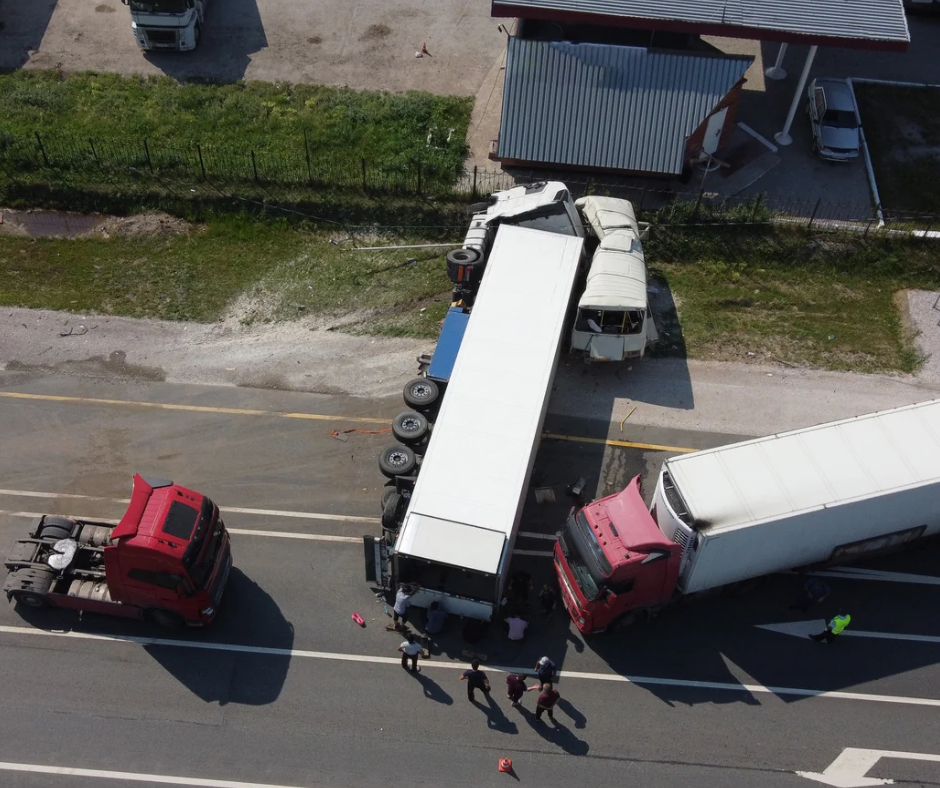
A jackknife accident happens when a semi-truck or 18-wheeler skids and the trailer swings out at a sharp angle to the cab, folding toward it like a pocketknife. The trailer can sweep across several lanes of a freeway, so these crashes often involve multiple vehicles and serious injuries. If you or someone you love was hurt in one, you are probably asking what a claim could be worth. This guide explains the general ranges, what moves them up or down, and what the process looks like, in plain English and Spanish.
Jackknife truck accident settlement ranges in California
| Case tier | General range | Typical injuries and case features |
|---|---|---|
| Moderate injuries | $75,000 to $300,000 | Broken bones, whiplash, herniated discs, soft tissue damage, or short-term disability with limited surgery |
| Severe injuries | $500,000 to $2,000,000+ | Complex surgery, severe orthopedic injuries, moderate traumatic brain injury (TBI), or permanent partial impairment |
| Catastrophic and fatal claims | $3,000,000 to $10,000,000+ | Spinal cord injury or paralysis, severe TBI, limb loss, or wrongful death claims with several layers of liability |
Ranges reviewed November 2026. They are general ranges shown for illustration. They are not an average, and they are not a prediction for any individual claim.
Key facts at a glance
- Filing deadline: Most California personal injury lawsuits must be filed within 2 years of the injury. A claim against a government entity can have a deadline as short as 6 months.
- Fault rule: California uses pure comparative negligence. You can recover even if you were partly at fault, but the total is reduced by your percentage of fault.
- Trucking insurance: Federal rules require most for-hire carriers hauling nonhazardous freight in vehicles of 10,001 pounds or more to carry at least $750,000 in liability coverage. Certain hazardous cargo requires more, up to $5,000,000.
- Time to resolve: Simple claims may settle in 6 to 12 months. Severe or catastrophic claims often take 12 to 24 months or longer.
- Cost to hire Kash Legal: Contingency fee. Clients owe nothing if the firm does not win.
Why there is no single average
Settlement figures for jackknife crashes are hard to boil down to one number. Many settlements are confidential. Published numbers often mix car, motorcycle, and truck claims. And a jackknife crash with a minor soft tissue injury is a very different case from one that leaves a driver with a spinal cord injury. A single average hides that spread, which is why the ranges above are broken out by injury severity.
What drives the value of a jackknife truck accident claim
No settlement is guaranteed, and each claim turns on its own facts. These are the factors that most often move the number. For a deeper look at each one, see our guide to jackknife accident settlement compensation factors.
1. Injury severity and medical costs
Medical damages are usually the largest driver. They can include emergency care, hospital stays, surgery, physical therapy, rehabilitation, and projected future care such as home modifications or long-term treatment.
2. Lost income and earning capacity
If injuries keep someone out of work, a claim can include lost paychecks. If injuries permanently limit the kind of work a person can do, a claim can also include the loss of future earning capacity.
3. Pain, suffering, and loss of quality of life
Truck crashes leave physical and emotional scars. California law allows injured people to seek non-economic damages for physical pain, emotional distress, post-traumatic stress, and reduced enjoyment of life. The statutory cap on non-economic damages in California applies to medical malpractice claims, not to truck accident claims.
4. The strength of the liability evidence
A claim is worth more when the proof of fault is clear. In jackknife cases, that proof often sits in the truck’s black box data, the driver’s logs, dispatch messages, and maintenance records.
5. Insurance coverage and the number of responsible parties
A claim can only be paid from the coverage that exists. Commercial carriers carry much higher limits than most passenger drivers, and more than one party may share responsibility. Identifying every policy layer matters.
6. Comparative fault
If an insurer argues the injured person was partly to blame, the total is reduced by that percentage. For example, if damages total $1,000,000 and you are found 20% at fault, the recovery is $800,000. Disproving false blame claims is a large part of the work.
How settlement amounts are calculated
Attorneys and insurers separate a claim into two kinds of damages. Economic damages are losses with a dollar figure. Non-economic damages are harder to measure, so they are usually proven through medical records, treating provider notes, and testimony from the injured person and family.
| Damage category | What it can cover | How it is usually documented |
|---|---|---|
| Past medical expenses | Ambulance, ER, hospital, surgery, therapy | Bills and medical records |
| Future medical care | Ongoing treatment, assistive equipment, home modifications | Physician opinions and a life care plan |
| Lost income | Time missed from work | Pay stubs, tax records, employer letters |
| Loss of earning capacity | Reduced ability to earn over a lifetime | Vocational and economic experts |
| Property damage | Vehicle repair or replacement | Repair estimates and appraisals |
| Non-economic damages | Pain, emotional distress, loss of enjoyment of life | Medical records, provider notes, personal testimony |
| Wrongful death (eligible family members) | Funeral and burial costs, loss of financial support, loss of love and companionship | Financial records and family testimony |
To estimate non-economic damages, insurers and attorneys sometimes use a multiplier on economic damages, often between 1.5 and 5 depending on severity, or a daily rate. Those are negotiating tools, not legal formulas. Settlement is also usually delayed until the injured person reaches maximum medical improvement (MMI), so that future care costs can be estimated with confidence. For families who have lost a loved one, our fatal truck accident settlement guide explains how those claims work.
What causes a jackknife accident
Finding the cause is how liability gets assigned. Common causes include:
- Abrupt or hard braking. The drive wheels can lock while the trailer keeps moving forward and swings out.
- Speeding or driving too fast for conditions. Rain, black ice, and slick pavement reduce traction.
- Improperly loaded or shifted cargo. Unbalanced freight can throw a rig off balance.
- Brake failure or poor maintenance. Neglected brakes and worn tires are frequent triggers.
- Driver fatigue. A tired driver may react late and brake suddenly.
- Road design or road conditions. Poor design, debris, or damaged pavement can contribute.
Who can be held responsible
Unlike many car accidents, a commercial truck crash can involve several responsible parties:
- The truck driver, for speeding, fatigue, distraction, or impairment.
- The trucking company (carrier), for negligent hiring or training, pressuring drivers to break hours-of-service rules, or failing to maintain vehicles.
- Maintenance contractors, for negligent repairs or missed inspections.
- Shippers and cargo loaders, for overloaded or poorly secured freight.
- Parts manufacturers, where a defective brake system or tire played a role.
Which of these parties is responsible depends on what the evidence shows.
Federal hours-of-service rules and why they matter
Federal hours-of-service (HOS) rules limit how long commercial drivers can drive, to reduce fatigue-related crashes. In a jackknife claim, logs that show a driver went over these limits can be strong evidence. They can also show whether the carrier pressured the driver to keep going. For the rules as they apply to property-carrying drivers, see the FMCSA’s summary of hours-of-service regulations.
| Rule | What it says for property-carrying drivers |
|---|---|
| 11-hour driving limit | May drive a maximum of 11 hours after 10 consecutive hours off duty |
| 14-hour limit | May not drive beyond the 14th consecutive hour after coming on duty, following 10 consecutive hours off duty |
| 30-minute driving break | Must take a 30-minute break after 8 cumulative hours of driving without at least a 30-minute interruption |
| 60/70-hour limit | May not drive after 60/70 hours on duty in 7/8 consecutive days, with a restart after 34 or more consecutive hours off duty |
Electronic logging devices (ELDs) record this data. The FMCSA explains how they work on its ELD page. Our article on how lawyers prove truck driver rest violations walks through what that proof looks like.
Case result: Kash Legal secured a $2.8 million settlement for a client injured in a jackknife truck accident on the I-15 in the High Desert. The case showed that the driver had violated federal hours-of-service regulations and that the trucking company had a history of pressuring drivers to exceed their limits. Past results do not guarantee future outcomes. Every case is different. See more on our client settlements page.
The evidence that can decide a jackknife claim
Trucking claims depend on technical evidence, and much of it is kept by the trucking company for a limited time.
| Evidence | What it can show | Why timing matters |
|---|---|---|
| Event data recorder (black box) and ECM data | Speed, braking, and steering input in the seconds before the crash | Data can be overwritten or lost when a truck is repaired or returned to service |
| ELD records and supporting documents | Hours driven, breaks taken, possible HOS violations | Carriers keep certain records for limited periods, so logs can cycle out |
| Driver qualification file and dispatch messages | Hiring and training history, and any pressure on delivery times | Internal records can change or disappear without a formal demand |
| Maintenance and inspection records | Brake condition, tire wear, and ignored defects | Records may be incomplete or replaced after a crash |
| Dashcam, traffic camera, and surveillance video | How the trailer began to swing out and how other vehicles reacted | Video is often recorded over after a short time |
| Scene evidence, weather, and the CHP report | Skid marks, road surface, lighting, and early facts | Scene conditions change quickly |
To protect this evidence, an attorney sends a preservation demand, also called a spoliation letter, to the trucking company and its insurer. At Kash Legal we treat evidence preservation as an emergency. We move quickly to secure ECM and black box data, driver qualification files, dispatch communications, and hours-of-service logs.
Insurance coverage in truck accident claims
A policy minimum is a floor, not a ceiling. Actual coverage can be higher, and some carriers add excess or umbrella layers.
| Vehicle or carrier type | Minimum liability coverage | Source |
|---|---|---|
| Most California passenger vehicles | $30,000 per person and $60,000 per accident for injury or death, and $15,000 for property damage (since January 1, 2025) | California DMV |
| For-hire carriers hauling nonhazardous freight in vehicles of 10,001 pounds or more | $750,000 | 49 CFR 387.9 |
| Carriers hauling certain hazardous materials | Higher tiers, up to $5,000,000 | 49 CFR 387.9 |
That gap is one reason a jackknife claim can be worth more than a typical car accident claim. It is also why identifying every available policy early matters.
Common first steps after a jackknife accident in California
This is general information, not legal advice. Steps people commonly take include:
- Call 911 and ask for police and medical help.
- Get medical care right away, even if you feel fine. Shock can mask serious injuries.
- Document the scene if you are able. Photos and video of vehicle positions, skid marks, road conditions, and the carrier’s name and logo can help.
- Collect witness details and the police report number.
- Consider speaking with an attorney before giving a recorded statement to the trucking company’s insurance adjuster.
California deadlines to know
Most California personal injury lawsuits must be filed within 2 years of the injury, under Code of Civil Procedure section 335.1. If a government entity may be responsible, for example a city-owned truck or a hazardous road design, a claim may have to be presented within as little as 6 months under Government Code section 911.2. Missing a deadline can end a claim, so it is wise to talk with an attorney early.
How long does a jackknife settlement take?
Simple claims with clear liability and fully resolved injuries may settle in 6 to 12 months. Severe or catastrophic claims often take 12 to 24 months or longer. The extra time usually has a reason: waiting for maximum medical improvement, negotiating with several insurers, or preparing for trial if the defense will not make a fair offer. Our jackknife claim settlement timeline breaks down each stage.
Frequently asked questions
What is the average settlement for a jackknife truck accident in California?
There is no official average. General ranges run from about $75,000 to $300,000 for moderate injuries, $500,000 to $2,000,000 or more for severe injuries, and $3,000,000 to $10,000,000 or more for catastrophic and fatal crashes. The amount depends on the injuries, the proof of fault, and the insurance coverage available. These ranges are informational and are not a prediction for any case.
Why can jackknife truck accident settlements be higher than car accident settlements?
A jackknifing trailer can sweep across several lanes, which often leads to multi-vehicle collisions and serious injuries. Commercial carriers also must carry higher insurance minimums than most passenger drivers, and more than one party may share responsibility. Those factors can raise the value of a claim, but no result is guaranteed.
How is a jackknife truck accident settlement calculated?
Economic damages, such as past and future medical bills, lost income, and property damage, are added to non-economic damages, such as pain, emotional distress, and loss of enjoyment of life. Insurers and attorneys sometimes estimate non-economic damages with a multiplier, often between 1.5 and 5 depending on severity, or with a daily rate. These are negotiating tools, not legal formulas.
Who can be held responsible for a jackknife truck accident?
Depending on the evidence, responsible parties can include the truck driver, the trucking company, a maintenance contractor, a shipper or cargo loader, and a parts manufacturer if a defect played a role. Identifying every responsible party can increase the insurance coverage available to the injured person.
What if I was partly at fault for the crash?
California follows pure comparative negligence. You can still recover compensation when you share some blame, but the total is reduced by your percentage of fault. For example, if damages total $1,000,000 and a jury finds you 20% at fault, the recovery would be $800,000.
How long do I have to file a jackknife truck accident lawsuit in California?
Most California personal injury lawsuits must be filed within 2 years of the injury. If a government entity may be responsible, such as a city-owned truck or a road-design issue, a claim may have to be presented in as little as 6 months. Deadlines vary with the facts, so it helps to speak with an attorney promptly.
How long does a jackknife truck accident settlement take?
Simple claims with clear liability and fully resolved injuries may settle in 6 to 12 months. Severe or catastrophic claims often take 12 to 24 months or longer, because attorneys usually wait until the injured person reaches maximum medical improvement so they can estimate lifetime care costs.
What evidence matters most in a jackknife truck accident claim?
Common examples are the truck’s event data recorder (black box) data, electronic logging device records, driver qualification and dispatch records, maintenance records, video footage, and the police report. Some of this evidence is kept only for a limited time, so a preservation letter, also called a spoliation letter, is usually sent quickly.
Can I afford a lawyer after a jackknife truck accident?
Kash Legal handles injury cases on a contingency-fee basis. Clients owe nothing if the firm does not win, and any legal fee is a predetermined percentage of the settlement or award when it does win. The first consultation is free.
How Kash Legal helps after a jackknife accident
Trucking companies and their insurers often send rapid-response teams to a crash scene within hours. Our goal is to make sure you are not facing them alone. Kash Legal is a California personal injury firm that prepares every case as if it may go to trial, and we explain each step in plain English so you always know where your case stands.
When we take a jackknife case, we move quickly to:
- Send preservation demands for black box data, ELD logs, dashcam video, and driver records.
- Work with accident reconstruction specialists to establish how and why the crash happened.
- Identify every available insurance policy and every potentially responsible party.
- Handle communications with insurance companies so you can focus on recovery.
- Help connect clients with doctors, imaging centers, and therapists who treat on a medical-lien basis, with payment deferred until the case resolves.
Kash Legal handles injury cases on a contingency-fee basis. Clients owe nothing if the firm does not win, and any legal fee is a predetermined percentage of the settlement or award when it does win. We offer free consultations, 24/7 case assessments, and Spanish-language service.
Get a free consultation about your California truck accident case
Call (888) 527-4128 or request a free case review. Learn more about our California truck and commercial vehicle accident practice.
Related reading
- Jackknife Truck Accident Settlement Compensation Factors Explained
- Jackknife Truck Accident Claim Settlement Timeline Explained
- Typical Truck Accident Settlements and Damages
- How Lawyers Prove Truck Driver Rest Violations
- Fatal Truck Accident Settlement Guide
- Maximizing a Tractor-Trailer Accident Settlement
Sources
- Federal Motor Carrier Safety Administration, Summary of Hours of Service Regulations
- Federal Motor Carrier Safety Administration, Electronic Logging Devices
- Electronic Code of Federal Regulations, 49 CFR 387.9, Financial responsibility, minimum limits
- California DMV, Auto Insurance Requirements
- California Courts Self-Help Center, Statutes of Limitations
- California Code of Civil Procedure, section 335.1
- California Government Code, section 911.2
- Cornell Legal Information Institute, Comparative Negligence
This article is attorney advertising and general information. It is not legal advice, and it does not create an attorney-client relationship. Visiting this page, submitting a form, or receiving a phone or email response does not create one. Representation begins only with a written retainer agreement. Settlement ranges and case results are informational and demonstrative, and they do not guarantee or predict the outcome of any case. See our legal disclaimer.