


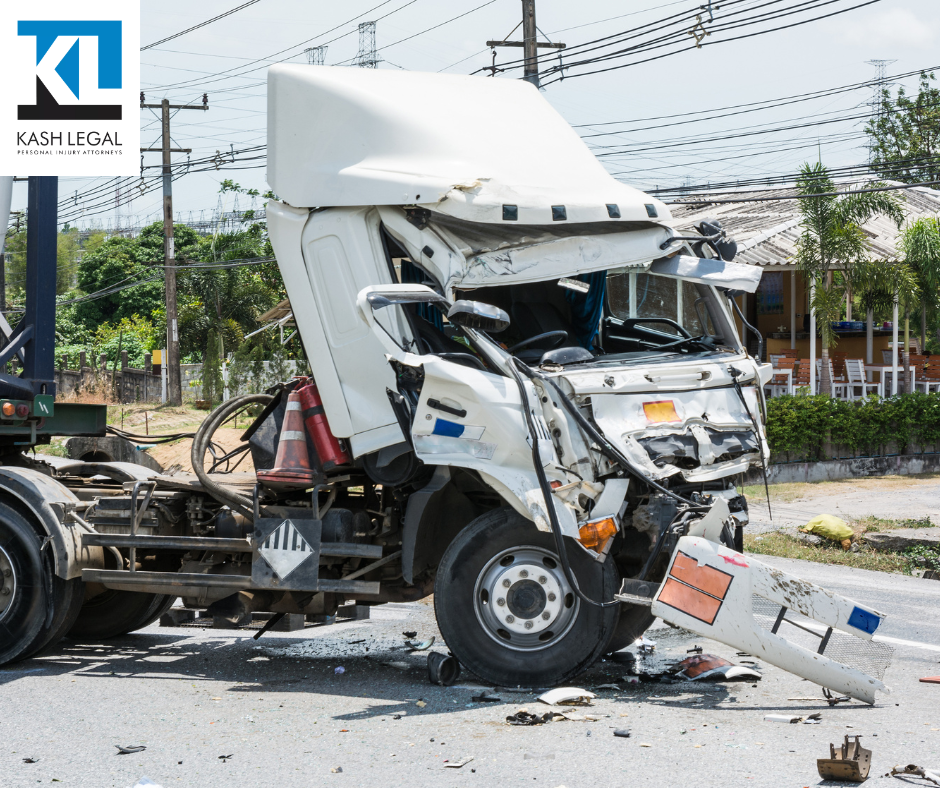
Experienced truck accident lawyers maximize payouts by preserving electronic evidence immediately, identifying every liable insurer, building expert teams to quantify all damages, and using real verdict data to anchor high‑value demands. With over 500,000 truck crashes occurring annually in the U.S.—causing roughly 155,000 injuries and 5,700 deaths—the financial stakes are enormous. Settlements range from $10,000 for minor injuries to multi‑million‑dollar verdicts for catastrophic harm. The six strategies below explain exactly how skilled attorneys in 2026 consistently recover more for their clients.
Kash Legal’s Approach to Maximizing Truck Accident Recoveries
Kash Legal Group is a California‑based, trial‑ready personal injury firm that has recovered over $1 billion for injured Californians. The firm operates on a strict No Fees Unless We Win contingency guarantee—meaning clients pay zero upfront costs regardless of case complexity or duration.
What sets Kash Legal apart is its combination of early aggressive investigation and willingness to take cases to trial. Most large trucking carriers employ in‑house legal teams and professional adjusters within hours of a crash. Kash Legal matches that urgency by deploying investigators immediately to secure evidence before it disappears.
The firm specializes in complex, multi‑defendant claims—cases involving the driver, carrier, broker, shipper, and equipment manufacturer simultaneously. This multi‑party approach is central to why Kash Legal clients consistently recover more than the average settlement. If you were hurt in a California tractor‑trailer crash, understanding your options as a truck accident victim is the critical first step.
Strategy 1: Early Evidence Preservation for Stronger Claims
Why the First 72 Hours After a Truck Crash Are Critical
The window to preserve the most powerful truck accident evidence is extremely narrow. Commercial trucks generate enormous amounts of digital data, but that data can be automatically overwritten within days unless an attorney acts immediately to demand its preservation.
Key Definition: Electronic Logging Devices (ELDs) and Event Data Recorders (EDRs) are federally mandated electronic systems installed in commercial trucks that automatically record driver hours, speed, braking force, acceleration, and crash‑related data in real time.
ELD and EDR data can be overwritten within 30 days—or sooner—unless a formal legal hold is issued. An experienced attorney sends a spoliation letter to the carrier within days of the crash, legally requiring them to preserve all relevant data.
What Evidence Lawyers Secure Immediately
The following evidence types are time‑sensitive and must be secured before they are lost, altered, or destroyed:
- ELD data – Records driver hours of service and violations of federal driving limits
- EDR (“black box”) data – Captures speed, braking, and steering inputs in the seconds before impact
- Dashcam and surveillance footage – Truck‑mounted or nearby commercial cameras with short recording loops
- Driver’s daily logbooks – Paper or digital records that can reveal Hours of Service (HOS) violations
- Driver qualification files – Hiring records, training history, prior violations, and drug/alcohol testing
- Vehicle maintenance records – Brake inspections, tire logs, and pre‑trip inspection forms
- Trucking company dispatch records – Communications revealing delivery pressure or unrealistic schedules
- Cell phone records – Evidence of distracted driving at the time of the crash
How Early Action Directly Affects Settlement Value
| Evidence Secured | What It Proves | Impact on Settlement |
|---|---|---|
| ELD/EDR data | Speed, fatigue, HOS violations | Establishes clear negligence; increases value significantly |
| Maintenance records | Brake/tire failure, ignored defects | Adds carrier liability; opens additional insurance policies |
| Dashcam footage | At‑fault driving behavior | Eliminates liability disputes; accelerates settlement |
| Driver qualification file | Prior violations, improper hiring | Supports punitive damages claims |
| Dispatch/communications | Delivery pressure, coercion | Proves corporate negligence beyond the driver |
Without immediate legal intervention, critical evidence disappears—and so does your leverage.
Takeaway: Without immediate legal intervention, critical evidence disappears—and so does your leverage.
Strategy 2: Multi‑Policy Exposure Analysis to Expand Compensation
What Is Multi‑Policy Exposure Analysis?
Multi‑policy exposure analysis is the process of identifying every potentially liable party in a truck crash—including the driver, motor carrier, freight broker, shipper, loading company, and equipment manufacturer—to access multiple separate insurance policies. A single truck crash can involve four to six defendants, each carrying their own coverage.
Key Definition: Multi‑policy exposure means that when more than one party is legally responsible for your injuries, their individual insurance policies can each be tapped, dramatically raising the total compensation ceiling.
Federal Minimum Insurance Requirements for Trucking Companies
Federal law requires interstate trucking companies to carry minimum liability insurance based on cargo type:
| Cargo Type | Federal Minimum Coverage |
|---|---|
| General freight (non‑hazmat) | $750,000 |
| Hazardous materials (certain types) | $1,000,000 – $5,000,000 |
| Passenger carriers (8+ passengers) | $1,500,000 – $5,000,000 |
| Oil/pipeline/utility cargo | $1,000,000 |
Many large carriers voluntarily carry $1 million or more in primary coverage, plus excess umbrella policies that can push total available coverage into the tens of millions.
Who Can Be Held Liable in a Truck Accident Claim?
Identifying every responsible party is one of the most valuable things a specialized attorney does. Defendants and their typical insurance minimums include:
- Truck driver – Personal auto/commercial policy; liability for negligent operation
- Motor carrier (trucking company) – Primary commercial auto policy ($750,000–$5M+)
- Freight broker – Contingent liability policy for improper carrier vetting
- Shipper or cargo loader – General liability policy for overloading or improper securement
- Truck/parts manufacturer – Product liability policy for defective equipment
- Truck maintenance provider – Professional liability for negligent repairs
- Leasing company – Ownership liability under some state laws
A victim who only pursues the driver’s carrier may leave hundreds of thousands of dollars—or even millions—unclaimed. Mapping every potentially liable entity and every layer of coverage expands the recovery pie and creates settlement pressure across multiple insurers.
How Attorneys Uncover Additional Coverage
- Policy layer audit: Identify primary, excess, and umbrella limits; look for MCS‑90 endorsements and self‑insured retentions.
- Corporate structure tracing: Determine parent/subsidiary relationships and additional insureds under master policies.
- Broker/shipper contracts: Analyze vetting obligations, indemnity, and control over routes/schedules that trigger liability.
- Equipment and maintenance trails: Track responsibility among owners, lessors, repair shops, and parts manufacturers.
- Permissive use/agency theories: Establish vicarious liability and non‑delegable duties under applicable law.
Practical Result (Illustrative)
A collision causes severe orthopedic and neurological injuries with lifetime care needs. Instead of stopping at the driver’s $1M primary policy, a thorough exposure analysis reveals: a $5M carrier umbrella, a $2M broker policy due to negligent carrier selection, and a $1M loader policy for improper securement—unlocking $9M in available limits and transforming the negotiation landscape.
Takeaway: Expanding the defendant pool expands the insurance pool—and your settlement leverage.
Strategy 3: Medical‑Forensic Valuation of Future Care and Lost Earnings
Translating Serious Injuries Into Full, Defensible Dollars
High‑stakes truck cases demand a rigorous, medical‑forensic valuation that insurers and juries can trust. Top attorneys assemble a valuation team to calculate both current and lifetime damages:
- Treating specialists and PM&R physicians: Document diagnoses, impairment ratings, and long‑term restrictions.
- Life‑care planners: Build a line‑item plan for future medical needs (surgeries, therapies, medications, equipment, home modifications, attendant care).
- Vocational rehabilitation experts: Assess transferable skills, post‑injury earning capacity, and work‑life expectancy.
- Economists: Present present‑value calculations with appropriate discount and medical inflation rates.
Key Damages Precisely Calculated
- Future medical care: Surgeries, injections, imaging, pain management, rehab, psychological counseling, and replacement cycles for equipment.
- Lost earning capacity: Wage differentials, loss of promotions/overtime, early retirement impacts, and fringe benefits.
- Household/ancillary services: Childcare, transportation, yard work, and caregiver support now required because of limitations.
- Non‑economic harms: Pain, suffering, loss of enjoyment of life—anchored to comparable verdicts and supported by day‑in‑the‑life evidence.
Documentation That Moves the Needle
- Longitudinal treatment records and imaging that show progression or permanence.
- Physician narrative reports connecting injuries to crash forces.
- Symptom journals, employer notes, and family statements corroborating daily limitations.
- Visuals: anatomical models, timelines, and medical illustrations that simplify complex conditions for adjusters and jurors.
Why It Increases Settlement Value
| Valuation Component | Insurer Reaction | Settlement Impact |
|---|---|---|
| Certified life‑care plan | Hard to refute; actuarially sound | Raises reserves; supports seven‑figure asks |
| Vocational + economist opinions | Quantifies future wage loss | Converts “speculative” to measurable |
| Treating doctor causation letters | Links crash to ongoing symptoms | Cuts off common defense arguments |
Takeaway: When every dollar is documented and defensible, insurers pay more—and pay sooner.
Strategy 4: Plaintiff Expert Architecture to Strengthen Liability and Damages
The Right Experts, in the Right Sequence
Building a winning expert lineup requires both breadth and coordination. Common plaintiff‑side experts in truck litigation include:
- Accident reconstructionists: Recreate speed, angle, and timing using EDR/ELD data, scene measurements, and photogrammetry.
- Trucking safety/FMCSA compliance experts: Identify HOS violations, negligent hiring/supervision, and systemic safety failures.
- Human factors experts: Explain perception‑reaction times, visibility, conspicuity, and distraction.
- EDR/ELD data analysts: Interpret raw datasets and confirm authenticity/continuity.
- Biomechanical engineers (as needed): Connect crash forces to injury mechanisms.
- Medical specialists (orthopedics, neurology, pain management): Diagnose, treat, and testify on causation and permanence.
- Life‑care planners, vocational experts, and economists: Quantify long‑term care and earnings losses.
- Fatigue/toxicology/sleep medicine experts: Prove impairment from fatigue, medications, or substances when relevant.
Cohesive Storytelling Beats “Expert Silos”
Top trial teams align expert opinions around a single timeline and theme, share assumptions, and pre‑visualize testimony with demonstratives: 3D scene models, route maps, dispatch logs, and dashcam overlays. This cohesion increases credibility and neutralizes defense attacks.
Daubert/Sargon‑Proofing and Visuals
- Vet methodologies and literature to withstand evidentiary challenges.
- Use clear visuals to translate technical findings into plain language for mediators and jurors.
Takeaway: A coordinated expert architecture turns complex trucking facts into a clear, compelling liability and damages narrative.
Strategy 5: Litigation Readiness and Calibrated Negotiation Tactics
Litigate Like You’ll Try the Case
- File early in a favorable venue and immediately notice depositions to demonstrate trial posture.
- Aggressive discovery: Target dispatch data, Qualcomm/telematics, safety manuals, prior incident histories, hiring/training files, and maintenance logs.
- 30(b)(6) corporate depositions: Lock in admissions on safety policies, hours‑of‑service monitoring, and driver supervision.
- Spoliation leverage: Seek sanctions or adverse inferences if critical ELD/EDR or video evidence was destroyed.
Demands That Move Carriers Off the Fence
- Time‑limited, policy‑limits demands with clear liability summaries, medical documentation, and itemized damages.
- Anchoring with verdict data from similar fact patterns to set realistic settlement brackets.
- Mediation strategy: Calibrated offers, strategic use of mediators’ proposals, and well‑timed brackets based on newly surfaced defense weaknesses.
- Bad‑faith exposure: Where applicable, document unreasonably low offers or delay tactics to increase insurer risk.
Takeaway: When the defense believes you’re ready for trial—and can win—authority increases and settlements follow.
Strategy 6: Leveraging Catastrophic and Wrongful‑Death Precedents
Turning Prior Results Into Today’s Settlement Leverage
- Comparable verdicts/settlements: Use jurisdiction‑specific outcomes with similar injuries, ages, and liability facts to justify non‑economic and future‑care numbers.
- Corporate negligence themes: Negligent hiring, inadequate training, dispatch pressure, and maintenance failures can support higher awards.
- Punitive exposure (egregious conduct): Repeated HOS violations, falsified logs, or intoxication can open the door to punitive damages in appropriate cases.
- Structured resolutions: Blend lump‑sum and structured payments to secure lifetime medical and income needs while maximizing net recovery after liens.
Takeaway: Real‑world precedents provide the roadmap—and the negotiating leverage—to reach best‑in‑class outcomes.
Frequently Asked Questions
- What should I do in the first 72 hours after a truck accident?
Secure medical care, photograph the scene/vehicles/injuries, collect witness info, and contact a truck accident lawyer to send preservation letters for ELD/EDR and video data. Avoid giving recorded statements to insurers before counsel. - How long do truck accident cases take to settle?
Many resolve within 6–18 months depending on medical recovery, liability disputes, and available policy limits. Catastrophic cases with extensive future‑care analyses can take longer. - How much is my truck accident case worth?
Settlements range widely—from tens of thousands for minor injuries to multi‑million‑dollar recoveries for catastrophic harm. Case value depends on liability strength, medical evidence, future care needs, lost earnings, and total available insurance. - Who pays my medical bills while the case is pending?
Options may include health insurance, MedPay, workers’ comp (if applicable), or medical liens coordinated by your attorney. Final medical liens are typically negotiated and paid from settlement proceeds. - What if I was partially at fault?
You may still recover compensation in many jurisdictions, but your award can be reduced by your percentage of fault. A lawyer can evaluate how comparative negligence rules apply to your facts. - How are truck accident claims different from car accident claims?
Truck cases involve federal regulations (ELDs, HOS), corporate safety policies, multiple defendants, higher policy limits, and complex data sources—creating more paths to prove negligence and expand compensation. - Should I speak with the trucking company’s insurer?
Not before consulting an attorney. Insurers may seek statements that minimize your injuries or shift blame. Your lawyer handles all communications to protect your claim. - What evidence should I try to preserve?
Photos/videos, dashcam footage, medical records, repair estimates, work/pay records, and a symptom journal. Your attorney will send formal holds for ELD/EDR data, driver files, dispatch records, and surveillance video. - What is a spoliation letter?
It’s a formal notice requiring the trucking company and other parties to preserve relevant evidence (ELD/EDR, logs, maintenance, video). Ignoring it can result in court sanctions or adverse inferences. - Will my case go to trial?
Most truck cases settle, but being truly trial‑ready often drives higher offers. If a fair settlement isn’t offered, trial may be the best path to full compensation. - Can I pursue punitive damages?
Potentially—particularly in cases involving intoxication, falsified logs, extreme speeding, or systemic safety failures. Availability depends on the facts and applicable law. - What’s the filing deadline?
Deadlines vary by state and claim type. Many personal injury claims must be filed within two years, with shorter timelines for claims involving government entities. Act quickly to protect your rights. - How much does it cost to hire a truck accident lawyer?
Kash Legal represents clients on contingency—No Fees Unless We Win. You pay nothing upfront; fees come from the recovery. - What is multi‑policy exposure and why does it matter?
It’s identifying every liable party (driver, carrier, broker, shipper, loader, manufacturer) and their separate insurance policies. More policies typically mean a higher potential recovery. - What are ELDs and EDRs again?
ELDs track driver hours and HOS compliance; EDRs capture pre‑impact data like speed and braking. Securing both early is critical to proving negligence.
Call Kash Legal for a FREE Consultation
Ready to protect your rights and maximize your recovery? Contact Kash Legal Group for a free, no‑obligation consultation. Our California truck accident lawyers are available 24/7, and we charge no fees unless we win. Start by understanding your options as a truck accident victim and get tailored guidance today.
Disclaimer: This article is for informational purposes only and does not constitute legal advice. Please consult an attorney for advice regarding your specific case.
About Us – Kash Legal
Kash Legal is a trusted California personal injury law firm known for delivering strong, client-focused advocacy to individuals and families harmed in accidents. With a reputation built on integrity, responsiveness, and consistent results, the firm handles a wide range of complex injury cases—from rideshare and motor-vehicle collisions to catastrophic injuries and wrongful death claims. As a BBB Accredited business, Kash Legal upholds high standards of professionalism and ethical service, giving clients confidence that their cases are handled with transparency and care. The firm’s commitment to personalized guidance and relentless negotiation has made it a respected resource for injury victims seeking justice and fair compensation.
Our office locations in California:
- Los Angeles (Beverly Hills): 2839 S. Robertson Blvd. Los Angeles CA 90034
- San Diego: 8775 Aero Dr Suite 138, San Diego, CA 92123 | (619) 650-5845
- Chula Vista: 750 Otay Lakes Rd, Chula Vista, CA 91910 | (619) 378-9288
- Reseda: 18355 Sherman Way, Reseda, CA 91335 | (747) 298-5611
- Murrieta: 25185 Madison Ave, Murrieta, CA 92562 | (951) 651-0774
- Temecula: 27555 Ynez Rd, Temecula, CA 92591 | (951) 484-1550
- Victorville: 14393 Park Ave, Victorville, CA 92392 | (760) 454-1654
- Hesperia: 17096 Sequoia St., Hesperia CA 92345 | (760) 919-4264
- Bakersfield: 2020 Eye St, Bakersfield, CA 93301 | (661) 460-2500
- Palm Desert: 74333 CA-111, Suite 205, Palm Desert, CA 92260 | (760) 529-8181
- Fresno: 4270 N Blackstone Ave Suite 201, Fresno, CA 93726 | (559) 551-2688
- Sacramento: 3626 Fair Oaks Blvd, Sacramento, CA 95864 | (916) 892-1263
- Roseville: 2999 Douglas Blvd Suite #180H, Roseville, CA 95661 | (916) 252-1165
- Oakland: 1300 Clay St, Oakland, CA 94612 | (510) 800-8293
- Pleasant Hill: 3478 Buskirk Ave suite 1054, Pleasant Hill, CA 94523 | (925) 940-9840
- Vacaville: 201 E Monte Vista Ave, Vacaville, CA 95688 | (707) 883-1555
- Fairfield: 1545 N Texas St, Fairfield, CA 94533 | (707) 881-9205
- San Jose: 111 North Market Street, Suite 300, San Jose, CA 95113
- Cupertino: 10080 N Wolfe Rd, Cupertino, CA 95014 | (818) 383-7478
- San Mateo: 1900 S Norfolk St #388, San Mateo, CA 94403 | (650) 629-1595